Nvidia CEO Calls on German Industry to Embrace AI Integration
Jensen Huang emphasizes that artificial intelligence will enhance, not replace, Germany's robust manufacturing sector.
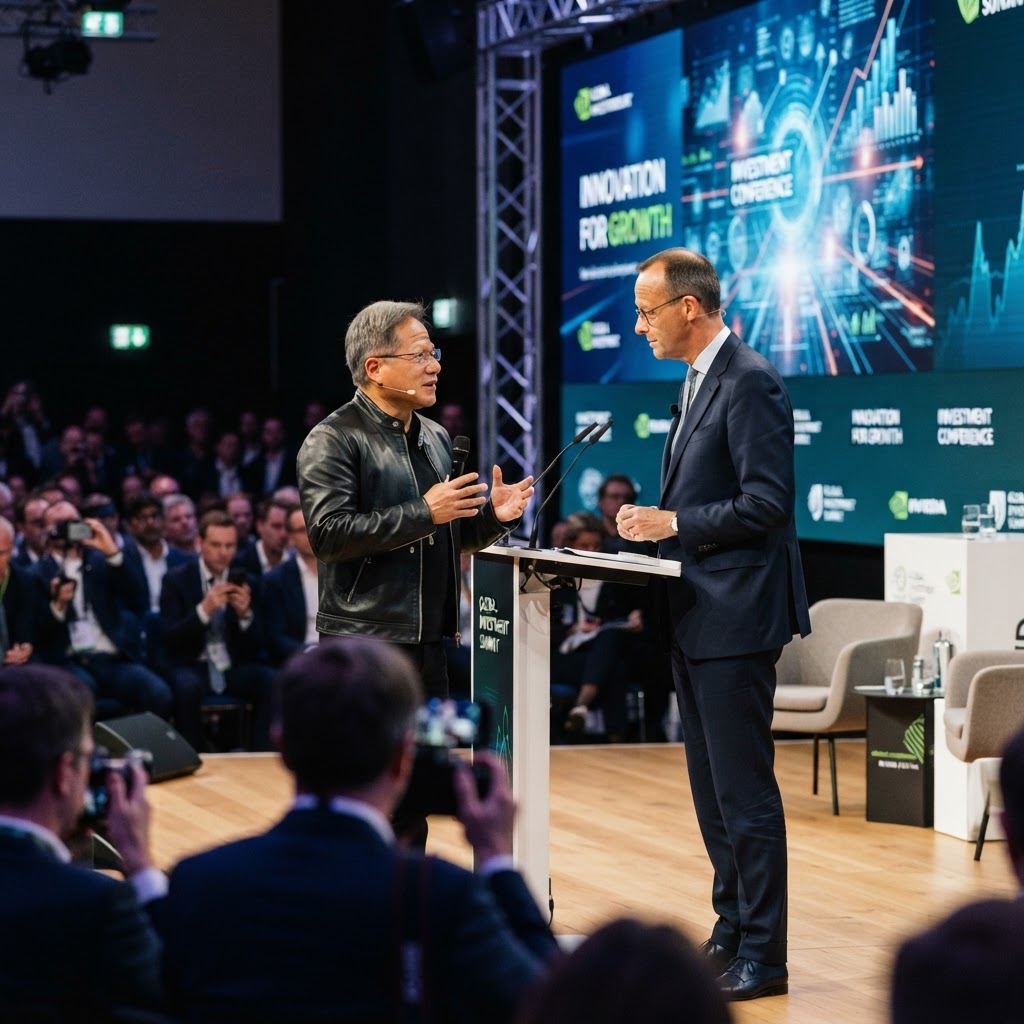
During a recent appearance at the Invest in Germany Summit in Berlin, Nvidia CEO Jensen Huang encouraged the nation's industrial leaders to accelerate their adoption of artificial intelligence. Speaking alongside German Chancellor Friedrich Merz, Huang argued that the country must leverage its deep reservoir of manufacturing data and engineering expertise to modernize its economic framework. He framed this transition as a vital opportunity to re-engineer the German business model in the face of recent economic stagnation.
Addressing concerns that automation might displace traditional labor, Huang offered a reassuring perspective, noting that digital advancements are intended to augment human capability rather than substitute for it. He famously remarked that while digital technology is transformative, "electrons will never replace atoms," highlighting that Germany’s core strength in producing physical goods like automobiles and industrial machinery remains foundational.
Huang identified the "physical" realm as the next major frontier for AI development, specifically pointing to robotics and heavy industry as sectors ripe for innovation. By integrating advanced computing into these fields, German companies can unlock new efficiencies. He urged local firms to treat their manufacturing data as a national natural resource, emphasizing that the current industrial revolution offers a unique window of opportunity that the country cannot afford to miss.
The discussion also touched upon the potential for Germany’s "mittelstand"—the network of specialized small- and medium-sized enterprises—to thrive through these technological upgrades. While acknowledging European concerns regarding reliance on U.S.-based computing infrastructure, Huang advised German leaders to import necessary AI tools while remaining protective of their own cultural values and proprietary knowledge. He encouraged the nation to take ownership of the programming and training of these systems to ensure they remain rooted in German expertise.
RELATED DISPATCHES



Discussion (0)
No comments yet. Be the first to join the discussion.