Trilateral Summit in Shenzhen Yields Symbolic Peace Declaration
President Trump, Xi Jinping, and Vladimir Putin conclude historic meeting with broad agreements but few concrete diplomatic breakthroughs.
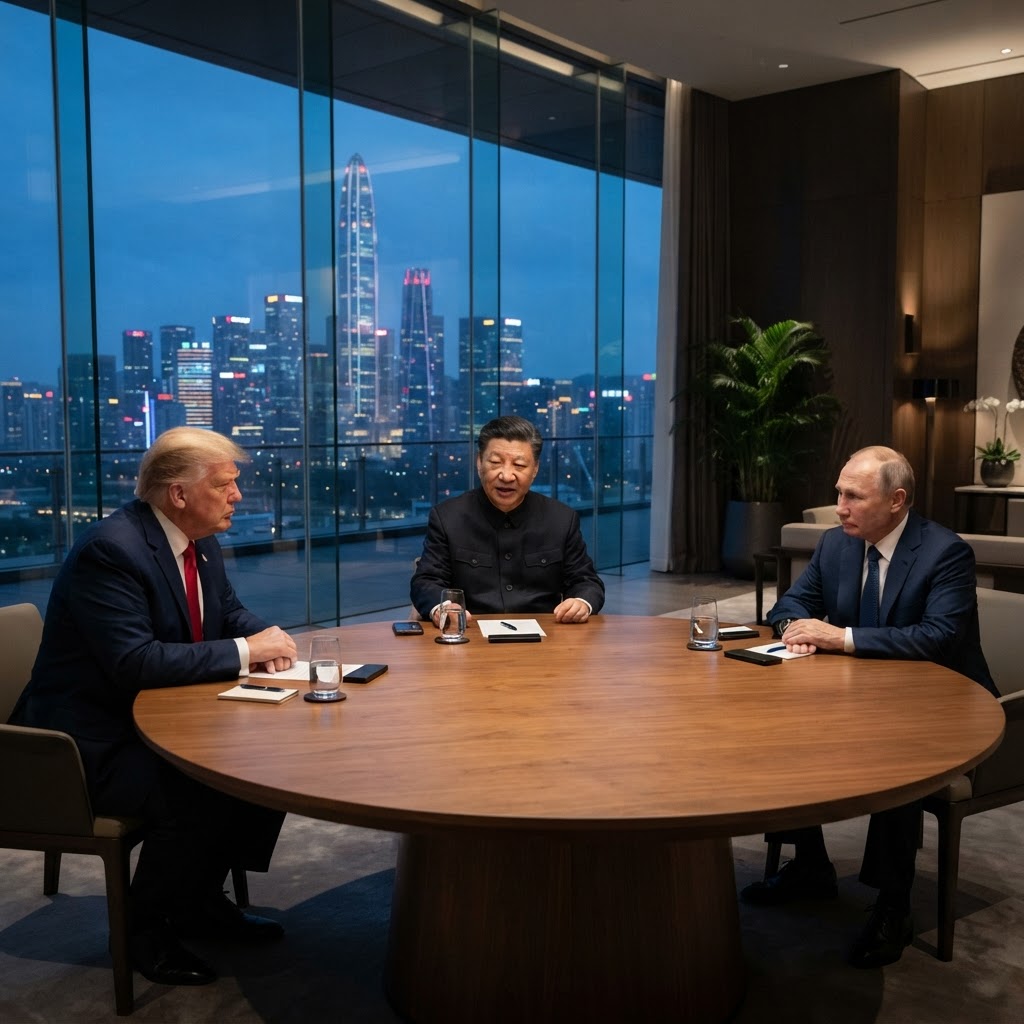
In a landmark gathering held in Shenzhen, China, U.S. President Donald Trump, Chinese President Xi Jinping, and Russian President Vladimir Putin met for the first-ever trilateral summit between the three global superpowers. While the meeting was framed as a significant diplomatic event, the leaders concluded their discussions with a symbolic four-point peace declaration that lacked substantive resolutions to ongoing global conflicts. The document focused on broad objectives, including United Nations reform, increasing global petroleum supplies, and a shared commitment to reducing nuclear risks.
Notably, the declaration remained silent on the ongoing war in Ukraine and the conflict involving Iran, despite these issues being central to international security concerns. While President Trump indicated that he held extensive discussions with President Putin regarding the situation in Ukraine, no formal agreements were reached. The summit served primarily as a platform for the leaders to project influence, with each head of state seeking to reinforce their respective positions on the world stage.
A significant portion of the dialogue centered on the International Criminal Court (ICC), with all three leaders expressing opposition to what they termed the "abuse of jurisdiction" by the body. This stance holds particular weight for President Putin, who faces an arrest warrant from the ICC, and aligns with the Trump administration's long-standing criticism of the court's authority over sovereign nations. The leaders emphasized that state officials should maintain immunity from such international legal proceedings.
Beyond traditional diplomacy, the summit took place against the backdrop of intense global competition in artificial intelligence. The meeting in Shenzhen, a major hub for technology and semiconductor manufacturing, highlighted the urgent challenges the U.S. faces in maintaining its edge in the AI sector. Recent domestic service outages in the U.S. and internal cabinet debates regarding the export of high-powered AI chips to China have underscored the complexity of managing technological supremacy in an era of rapid innovation.
Ultimately, the summit was viewed by many analysts as a strategic photo opportunity rather than a pivot point for international relations. While the leaders affirmed the importance of maintaining dialogue to prevent global chaos, the lack of concrete policy shifts suggests that the "seeds" of cooperation mentioned by President Xi have yet to yield tangible results. President Trump is expected to provide further details on the trip during a forthcoming press conference at the White House.
RELATED DISPATCHES

Discussion (0)
No comments yet. Be the first to join the discussion.